Get ready for your license test with AI assistance!
You are driving a motor vehicle with a manual gearbox on a level carriageway. How should you change gears so as to drive in a particularly environmentally conscious and economical way?
Changing up gears as early as possible
Changing down again as late as possible
Drive until the upper engine speed range is reached in one gear, before changing up
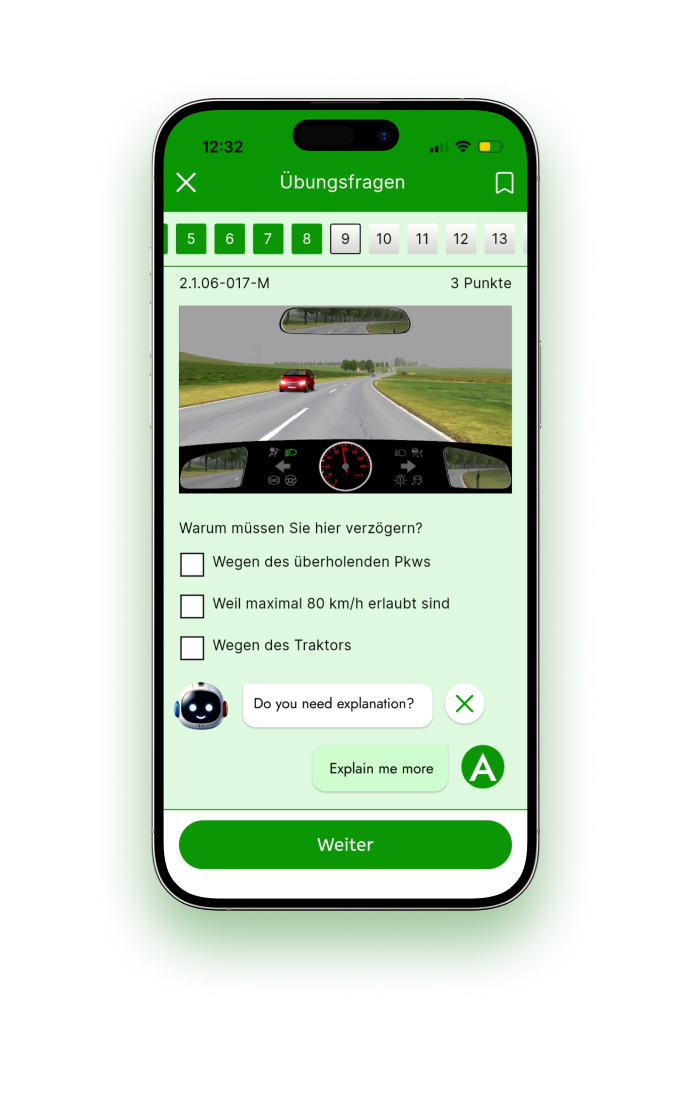
Here is Our AI Assistant's Explanation
To drive economically with a manual gearbox on a level road, you should keep engine speed low and avoid unnecessary fuel-consuming revs.
Answer 1 is correct because shifting up early puts the engine into a lower RPM range where it usually needs less fuel for the same steady speed. A practical rule of thumb is to accelerate moderately and shift up as soon as the engine runs smoothly without “lugging” (shaking or struggling).
Answer 2 is correct because shifting down late means you don’t increase RPM unless it’s really necessary. A downshift raises engine speed and often increases fuel use, so you should only downshift when the engine would otherwise run rough, you need more power (e.g., to accelerate), or your speed drops so much that the current gear no longer fits.
Answer 3 is wrong because driving each gear into the upper RPM range before shifting up wastes fuel on a level road. High revs are mainly useful when you actually need strong acceleration or power, not for normal economical driving.
Key takeaway: In normal conditions, “early upshift, low RPM, avoid high revs, downshift only when needed” is the eco-driving pattern.